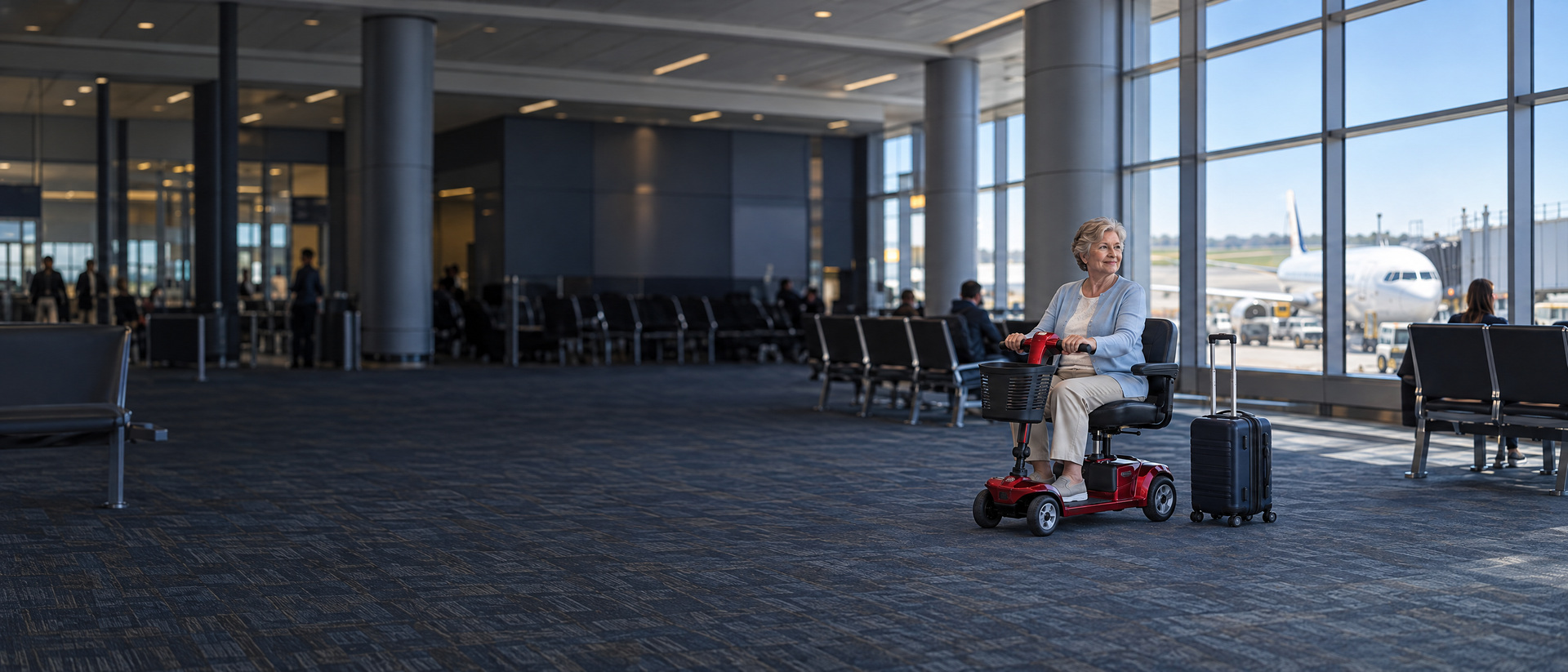
Yes, you can bring a mobility scooter on an airplane. In fact, federal law protects your right to fly with it. TSA officers screen scooters every day, and the FAA sets clear battery rules that every U.S. airline follows. The key is knowing those rules before you get to the airport.
This guide walks you through every step of the trip. You will learn how TSA screening works and which batteries are allowed. You will also learn how to protect your scooter in the cargo hold and when renting at your destination is the easier choice. We checked each rule against current TSA, FAA, and U.S. Department of Transportation (DOT) guidance in November 2026.
Quick answer: U.S. airlines must let you bring a mobility scooter on an airplane as an assistive device under the Air Carrier Access Act. You can ride it through TSA screening and up to the gate. Then the airline loads it into the cargo hold and returns it to you at the aircraft door. If you remove a lithium-ion battery, it must be 300 watt-hours or less, and it must travel with you in the cabin.
In this guide:
- Your rights under federal law
- TSA screening at the security checkpoint
- FAA battery rules and watt-hour limits
- Step-by-step travel checklist
- Gate check or counter check
- How to prevent damage
- Choosing travel-friendly equipment
- Renting at your destination
- Frequently asked questions
Your Right to Bring a Mobility Scooter on an Airplane
The Air Carrier Access Act (ACAA) bans disability discrimination in air travel. Under this law, an airline must accept your battery-powered scooter and its battery whenever the cargo hold has room and the aircraft can carry it safely.
Before you bring a mobility scooter on an airplane, it helps to know exactly what the law guarantees. Here are the protections that matter most:
- Not regular luggage. Your scooter travels as an assistive device, separate from your bags. Smaller assistive devices you bring on board also do not count toward your carry-on limit.
- Priority in the cargo hold. Wheelchairs and scooters go in before other bags. Airlines must also unload them among the first items.
- Return at the aircraft door. The airline must bring your scooter back as close as possible to the door of the plane, unless you ask to pick it up at baggage claim.
- Loading updates. Before the cabin door closes, the airline must tell you whether your scooter made it onto the flight.
- Limited advance notice. Airlines generally cannot require advance notice. They may ask for up to 48 hours’ notice in a few cases, such as special packaging for a battery or an electric wheelchair on a plane with fewer than 60 seats.
- Earlier check-in. An airline may ask you to check in one hour before the general public when you travel with a battery-powered mobility device.
- No doctor’s note. In most cases, an airline cannot require a medical certificate simply because you have a disability.
Even so, each airline can set stricter battery and size rules. That is why a quick call to your airline’s accessibility desk is worth it.
What About International Flights?
Foreign airlines must follow the ACAA when you bring a mobility scooter on an airplane that departs from or lands in the United States. However, flights between two other countries fall under local rules, which can differ. If your trip includes a partner airline or a connection abroad, confirm the battery and size rules with each carrier before you book.
TSA Rules for Taking a Mobility Scooter Through Security
Every day, TSA officers help travelers who bring a mobility scooter on an airplane, so the process is routine. According to TSA’s disabilities and medical conditions guidance, all passengers and their property must go through screening. However, you do not have to leave your scooter if you cannot stand or walk.
Here is what to expect at the checkpoint:
- Tell the officer what you can do. Let the TSA officer know whether you can walk or stand on your own. If standing is hard, you can ask for a chair or ask to stay seated on your scooter.
- Expect a scooter inspection. Officers check the scooter, the seat cushion, and any pouches that you cannot remove. They also swab it to test for traces of explosives.
- Send loose items through the X-ray. Take off baskets, bags, and other removable items so they can go through the X-ray machine.
- Get screened yourself. If you can stand and walk, you will go through the screening technology. If you cannot, an officer of the same sex will give you a pat-down. You can also ask for private screening at any time.
- Age 75 or older? In standard lanes, travelers 75 or older who use a wheelchair or scooter may stay seated while an officer tests their hands for explosive traces.
- PreCheck makes it easier. In TSA PreCheck lanes, anyone who cannot stand or walk may stay seated on the mobility device during screening.
Get Extra Help From TSA Cares
For extra support, call TSA Cares at (855) 787-2227 at least 72 hours before your flight. The team can explain what to expect at your airport. It can also arrange for a Passenger Support Specialist to help you through the checkpoint. In addition, you can hand officers a TSA Notification Card to share your needs quietly. If anything goes wrong, ask to speak with a TSA supervisor right away.
FAA Battery Rules for Your Mobility Scooter
Batteries cause more confusion than anything else when people bring a mobility scooter on an airplane. Fortunately, the FAA PackSafe rules for wheelchairs and mobility devices are clear once you know your battery type. To find it, check your owner’s manual or the label on the battery.
| Battery type | Can it stay in the scooter? | Spare battery rules |
|---|---|---|
| Lithium-ion (common on travel scooters) | Yes, if it is securely attached and the scooter’s design protects it. If not, remove it and carry it on board. | A removed battery must be 300 Wh or less. You may carry one spare up to 300 Wh or two spares up to 160 Wh each, in carry-on bags only. |
| Non-spillable sealed lead-acid (gel or AGM) | Yes, if it is secure, protected from damage, and the terminals are covered. | One spare per passenger, in strong, rigid packaging that follows airline instructions. |
| Spillable (wet cell) | Only if the airline can load and store the scooter upright. | The airline may remove the battery and package it separately. |
| Lithium metal (non-rechargeable) | Not allowed. | Not allowed. |
If you remove a lithium-ion battery, cover the terminals with tape or the original caps to prevent a short circuit. Next, place the battery in a protective pouch and keep it in your carry-on bag. You must also tell the airline where the battery is, because the crew has to tell the pilot where it is.
Federal rules protect your battery, too. Airlines must not drain it. They also must not disconnect a non-spillable battery that sits fully enclosed inside the scooter’s built-in case, unless a safety regulation requires it.
How to Find Your Battery’s Watt-Hours
Most lithium-ion batteries list watt-hours (Wh) on the label. If yours does not, multiply the volts by the amp-hours. For example, a 25.2-volt battery rated at 10 amp-hours equals 252 Wh, which is under the 300 Wh limit. On the other hand, a 24-volt battery rated at 15 amp-hours equals 360 Wh, which is over the limit for a removed battery.
Knowing this number is one of the most useful things you can do before you bring a mobility scooter on an airplane. Keep a copy of the battery spec sheet on your phone and on paper. A gate agent may ask for proof of the watt-hour rating, especially when the label is worn or hard to read.
Step-by-Step Checklist to Bring a Mobility Scooter on an Airplane
A little planning makes it much easier to bring a mobility scooter on an airplane. Follow these steps in order, and you will be ready for every stage of the trip.
Before You Leave Home
- Gather your scooter details. Write down the make, model, weight, folded size, battery type, and watt-hours.
- Call your airline when you book. Ask about its mobility device policy and confirm the aircraft for every flight. Regional jets have smaller cargo doors, so a scooter that fits one plane may not fit the next.
- Add assistance to your reservation. Request wheelchair or boarding help, and fill out any mobility device form the airline uses.
- Contact TSA Cares. Call at least 72 hours before departure if you want help at the checkpoint.
- Charge the battery fully. Then pack the charger in your carry-on bag so it does not get lost.
- Make an instruction card. Tape a simple, laminated card to the scooter. Explain how to put it in freewheel mode, how to fold or take it apart, and how to disconnect the battery.
- Take photos. Photograph your scooter from every side so you have a record of its condition.
At the Airport and After You Land
- Arrive early. Plan for extra time, since an airline may ask you to check in one hour before the general public.
- Tell the check-in agent. Let the agent know you plan to ride your scooter to the gate. Ask for a gate-check tag with your name and destination.
- Remove loose parts. At the gate, take off the key, basket, mirrors, and the seat cushion if it lifts off. Bring these items on board so nothing gets lost.
- Preboard if you can. Preboarding gives you time to settle in and talk with the crew about your scooter.
- Confirm it is on board. Before the cabin door closes, ask a flight attendant to confirm that your scooter is on the plane.
- Inspect it at the door. When you land, check your scooter carefully before you leave the airport. If you find damage, report it right away and ask for a written report.
Gate Check or Counter Check: Which Is Better?
Most travelers who bring a mobility scooter on an airplane choose to gate check it, and for good reason. You keep your independence all the way to the jet bridge. In addition, your scooter spends less time in the baggage system, so it has fewer chances to get bumped or dropped.
Checking your scooter at the ticket counter can still make sense, though. For example, it may help if your scooter is too heavy or too large to move around a crowded gate area. In that case, ask the airline for an airport wheelchair and an assistant to take you to the gate. Either way, the airline should return your scooter at the aircraft door unless you request baggage claim.
How to Protect Your Mobility Scooter From Damage
Most mobility devices arrive safely, but damage does happen. In 2025, U.S. airlines carried 907,259 wheelchairs and scooters and mishandled about 1.09% of them, based on DOT data reported by WheelchairTravel.org. That adds up to nearly 10,000 devices in a single year.
Every time you bring a mobility scooter on an airplane, a few simple steps can lower your risk:
- Fold down the tiller and lock it so it cannot swing.
- Wrap the controls and display with bubble wrap or a padded cover.
- Remove mirrors, baskets, and anything else that could snap off.
- Bundle loose cables with zip ties so they cannot catch on other cargo.
- Attach your instruction card where baggage handlers will see it.
- Keep your photos, battery spec sheet, and flight details together in one place.
There is some good news, too. As of June 17, 2026, airline workers who assist passengers or handle wheelchairs and scooters must have completed hands-on training. However, DOT has paused enforcement of several newer protections, including some damage rules, through April 30, 2027. As a result, your own photos and records matter more than ever.
If your scooter does come back damaged, ask for the airline’s Complaints Resolution Official (CRO) before you leave the airport. After the trip, have a qualified technician inspect the frame, wiring, and battery connections. Our electric scooter and wheelchair maintenance checklist shows what to look for. It is also smart to review your mobility scooter insurance options before you travel.
Choosing a Travel-Friendly Scooter or Folding Power Wheelchair
If you plan to bring a mobility scooter on an airplane often, the scooter itself matters as much as the paperwork. Full-size scooters are heavy, and they can be hard to fit through small cargo doors. Travel scooters, on the other hand, fold or come apart in seconds.
Look for these features when you shop:
- Lithium-ion battery rated at 300 Wh or less
- Tool-free battery removal
- Clear battery label that lists watt-hours
- Light frame that folds or separates into small pieces
- Compact folded size that fits through regional jet cargo doors
Mobility City carries several travel-friendly mobility scooters. For example, the Go Go® Endurance AL+ offers feather-touch disassembly and a lightweight lithium-ion battery in a compact design. To compare more models, read our guide on how to choose the best mobility scooter for your needs.
Some travelers prefer a power chair instead. Our travel folding power wheelchairs fold down small enough to store in tight spaces. The AEROLUX Power Wheelchair by Travel Buggy, for instance, is a cross-folding carbon fiber chair that weighs around 33 pounds. Before you choose any model for air travel, ask our team to confirm its battery rating and folded size.
When Renting a Mobility Scooter at Your Destination Makes Sense
Sometimes the easiest option is to leave your own scooter at home. Renting is a smart choice when you would rather not bring a mobility scooter on an airplane at all. It works especially well in these situations:
- Your scooter is a heavy, full-size model.
- It uses a spillable battery or a lithium-ion battery over 300 Wh.
- Your trip includes small regional jets with tight cargo doors.
- You are taking a short trip and want to avoid any risk of damage.
- You need a scooter for a cruise, theme park, or family event after you land.
Mobility City offers flexible mobility equipment rentals by the day, weekend, week, or month. Our team can deliver your scooter, set it up, and show you how to use it with confidence. For more planning ideas, see our tips for renting mobility equipment while traveling.
Frequently Asked Questions About Flying With a Mobility Scooter
Can I ride my mobility scooter to the gate?
Yes. In most cases, you can ride your scooter through security and all the way to the gate. Airline staff then load it into the cargo hold and bring it back to the aircraft door when you land.
Do I have to remove my scooter battery before flying?
It depends on the battery. A lithium-ion battery can usually stay in place if the scooter’s design protects it. Otherwise, you must remove it, protect the terminals, and carry it on board. Some airlines require removal for every lithium-ion battery, so check with your airline first.
Can my scooter ride in the airplane cabin?
Usually not. Powered scooters almost always travel in the cargo hold. However, any removed lithium-ion battery and all spare batteries must travel in the cabin with you.
How early should I get to the airport?
Plan to arrive earlier than usual. Airlines may ask travelers with battery-powered mobility devices to check in one hour before the general check-in time. Extra time also helps with TSA screening and the gate check process.
Do I need a doctor’s note to fly with a mobility scooter?
No. Under federal rules, an airline generally cannot require a medical certificate just because you have a disability. There are a few exceptions, such as travelers who need medical oxygen during the flight.
What should I do if the airline damages my scooter?
Report the damage before you leave the airport. Ask for a written report and the airline’s Complaints Resolution Official. Then take photos, save your records, and have a qualified technician inspect the scooter as soon as possible.
Can I bring a spare scooter battery?
Yes, within limits. For lithium-ion batteries, you can bring one spare up to 300 Wh or two spares up to 160 Wh each. Spares must always travel in your carry-on bag and never in checked luggage.
Fly With Confidence and Keep Moving
So, can you bring a mobility scooter on an airplane? Absolutely. Know your rights, learn your battery type, and plan each step before you go. With that preparation, your scooter can be waiting for you at the aircraft door when you land.
Need a scooter built for travel, or would you rather rent one at your destination? Mobility City is here to help. Explore our mobility scooters, compare folding power wheelchairs for travel, or reserve a scooter rental for your next trip.