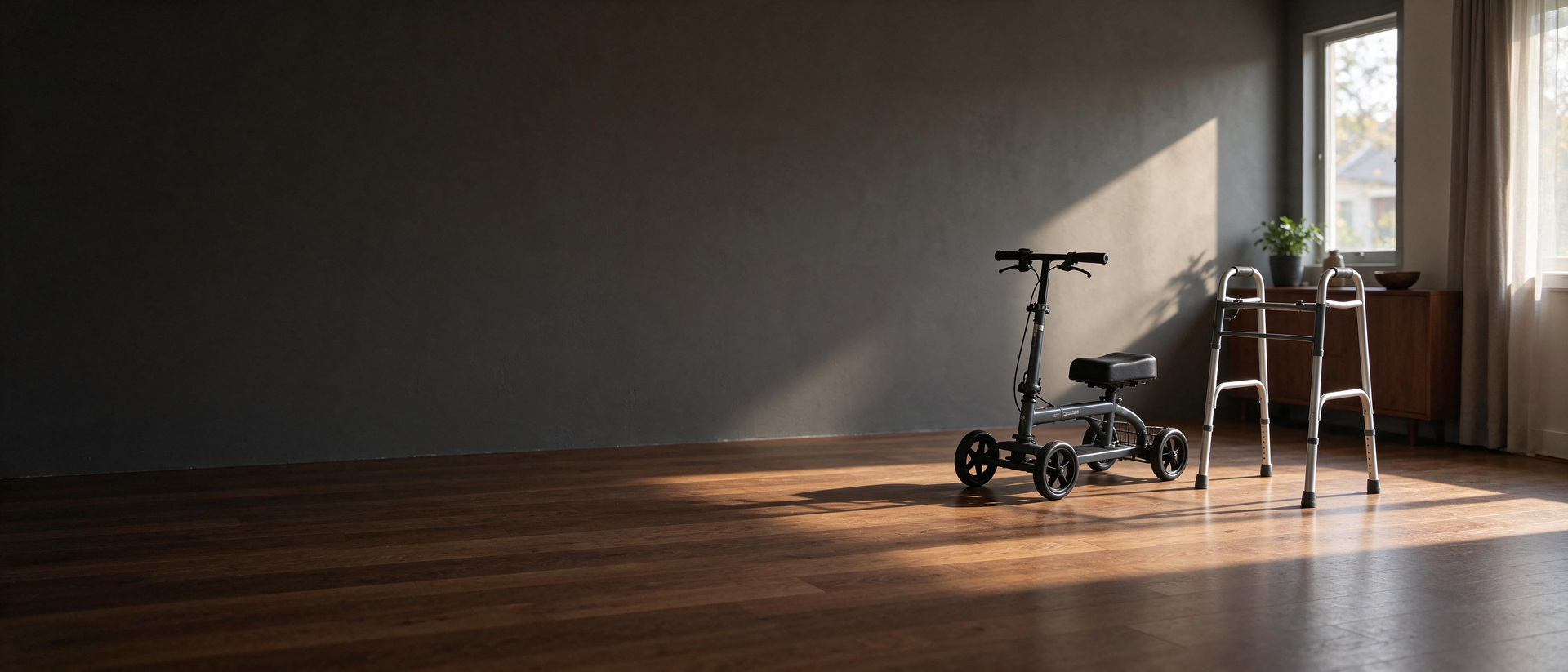
The knee scooter vs walker question comes up for almost everyone facing foot or ankle surgery. Your surgeon tells you to keep all weight off the foot for weeks, and now you need a way to get around. Both devices can do that job. However, they work in very different ways, so the right choice depends on your body, your home, and your surgery.
This guide compares the research, the safety data, and the daily tradeoffs. One quick note on names: many people call a knee scooter a knee walker. In this guide, “walker” means a standard walker frame that you lift or slide.
Quick answer: For most adults with good balance and a strong non-operated leg, a knee scooter is faster, easier, and less tiring than a walker on flat floors. In one study of adults aged 50 to 67, people moved about three times faster on a knee walker than with a walker. They also rated it as less than half the effort. Still, a walker can be the better choice if you have balance or vision problems, a sore knee on your surgery side, or a very tight home. Neither device is safe on stairs. So the best plan starts with a talk with your surgeon or physical therapist.
This guide is general information, not medical advice. Always follow your surgeon’s weight-bearing orders, and ask your therapist to fit and train you on any device.
In this guide:
- Knee scooter vs walker at a glance
- What non-weight-bearing means
- What the research says
- Safety data
- When a walker is better
- When a knee scooter is better
- Which one fits your home
- Fitting and using a knee scooter
- Fitting and using a walker
- When a wheelchair beats both
- Getting your device before surgery
- Frequently asked questions
Knee Scooter vs Walker at a Glance
Here is how the knee scooter vs walker match-up looks side by side. The speed and effort figures come from a 2021 study of healthy adults aged 50 to 67 in Foot & Ankle Orthopaedics. The safety rules come from leading orthopedic and hospital sources.
| Feature | Knee scooter | Standard walker |
|---|---|---|
| How you move | Rest your knee on a pad and push with your good leg | Move the frame ahead, then hop on your good leg |
| What holds you up | The knee pad and your good leg | Mostly your arms and your good leg |
| Speed in the study | About 2.9 mph, close to normal walking | About 0.9 mph, the slowest option |
| Effort score (0 to 10) | 2.7 | 6.1 |
| Finished a 656-foot walk | All 21 people | 6 of 21 people |
| Stairs | Never | Never |
| Tight turns | Slow, wide, or 3-point turns | Small hops let you turn in tight spots |
| Carrying things | Add a basket | Needs a backpack or apron pocket |
| Moving to partial weight | Not built for it | Lets you add weight bit by bit |
| Often best for | Good balance and longer trips | Balance concerns and short trips |
In short, a knee scooter usually wins on speed and comfort. A walker, on the other hand, keeps four fixed legs on the floor and gives you more control in tight spots. The rest of this guide explains why.
What Non-Weight-Bearing Means After Foot Surgery
Before you compare devices, it helps to know what your surgeon is asking. Non-weight-bearing (NWB) means no weight at all on the operated foot. The American Orthopaedic Foot & Ankle Society (AOFAS) puts it plainly in its FootCareMD guide. You should put no weight on the foot, “not even for a second or two,” whether you are standing or seated.
That rule matters because most people cannot judge how much weight they put on a foot, even when they barely touch the floor. AOFAS explains that weight too soon can damage the repair. Bones need time to heal, and plates and screws need bone to grow around them. In addition, incisions heal better without stress, and staying off the foot helps limit swelling.
A patient guide from University Hospitals Dorset, part of the UK’s NHS, adds that the rule applies when you stand up and sit down, too. It also warns that ignoring it is likely to cause the operation to fail. How long NWB lasts depends on your procedure and how you heal. In that hospital’s program, the first follow-up visit comes 2 to 6 weeks after surgery. At that visit, the surgeon decides when you can start to bear weight.
So the real goal is simple. You need a device that lets you live your daily life for weeks without your foot ever touching down. Both a knee scooter and a walker can do that. Even so, they ask very different things of your body.
How a Knee Scooter Works
A knee scooter has a padded knee platform, four wheels, handlebars, and hand brakes. You bend the knee of your injured leg and rest your shin on the pad. Your foot and ankle hang off the back, safely off the floor. Then you push forward with your good leg, much like riding a kick scooter.
Mayo Clinic notes that knee walkers are typically used for ankle or foot problems. Alberta Health Services adds that the design lets you move without using too much of your upper body. That is the big difference from a walker. Your arms steer and brake, but they do not carry your full weight with every step.
Most models have adjustable pad and handlebar heights, and many fold for the car. AOFAS also lists handy add-ons such as a basket, a cup holder, and non-skid wheels. Some all-terrain models have bigger tires for outdoor use, which our knee walker rental guide covers in more detail.
However, a knee scooter has clear limits. You need a strong, healthy non-operated leg and good balance. You also need a knee on the surgery side that can bend to about 90 degrees and take pressure. Finally, it can never go on stairs.
How a Walker Works When You Cannot Bear Weight
A standard walker is a light metal frame with four legs and handgrips. The American Academy of Orthopaedic Surgeons (AAOS) says a pickup walker with four legs gives you the most stability. Some walkers have two front wheels, so you can slide them instead of lifting them. Your therapist will choose the type that suits you.
With NWB orders, you do not step through a walker. Instead, you hop. You hold the operated foot off the floor, lean on the frame with both arms, and hop forward on your good leg. In other words, your arms and one leg carry your whole body with every hop. This hop is the heart of the knee scooter vs walker difference.
The Non-Weight-Bearing Hop With a Walker
The University Hospitals Dorset guide describes the technique in three steps:
- Stand holding the walker with your operated foot clear of the floor.
- Place the walker out in front of you.
- Lean your weight through the walker and hop forward, keeping your operated leg clear.
This takes real strength. As a result, many people can only hop short distances before they need a rest. For example, a trip from the bedroom to the kitchen can feel like a workout in the first few days.
Why a Rollator Is Not the Same
A rollator is a walker with three or four wheels, hand brakes, and often a seat. It is great for longer walks once you can bear weight. However, Mayo Clinic notes that four-wheeled walkers tend to be less stable than standard walkers. Since a hop puts all of your weight through your hands, a frame that rolls is a poor fit for strict NWB. So ask your therapist before you use one during this stage.
What the Research Says About Knee Scooter vs Walker Use
Several studies have tested the knee scooter vs walker question in a lab. The results lean strongly one way, though they come with limits worth knowing.
Speed: Knee Scooter vs Walker
In the 2021 Foot & Ankle Orthopaedics study, researchers at the University of Saskatchewan in Canada asked 21 healthy adults aged 50 to 67 to walk 200 meters without using one leg. That is about 656 feet. Each person tried crutches, a standard folding walker, and a knee walker. They also walked normally for comparison.
With the knee walker, people moved at about 2.9 mph. That is close to their normal pace of about 3.2 mph. With crutches, they slowed to about 1.7 mph. Meanwhile, the walker was the slowest by far at about 0.9 mph. So the knee walker was roughly three times faster than the walker.
Finishing the course was another story. All 21 people completed the walk on the knee walker. But 15 of the 21 could not finish it with the walker, and 11 could not finish with crutches.
Effort: A Knee Scooter Takes Less Than Half the Work of a Walker
People also rated how hard each device felt on a scale of 0 to 10. The knee walker scored 2.7, compared with 5.7 for crutches and 6.1 for the walker. In fact, 20 of the 21 people said they would choose the knee walker.
Other research backs this up. A 2016 study in Physiotherapy measured energy use in 10 healthy adults. With a knee walker, energy use was close to normal walking. It was also much lower than with a walking frame or crutches. The authors note that earlier work found crutch walking can double the energy you use.
Less Strain on Your Good Leg and Arms
Your good leg does double duty while you heal, so protecting it matters. In the 2021 study, the standing foot spent about 89% of the walk bearing weight with the walker. With the knee walker, that number dropped to about 48%. The average force on the standing foot was also at least 75% lower with the knee walker than with any other option.
The authors also point to earlier work showing that standard aids can cause hand, underarm, or leg pain in 68% of users. That kind of pain is one reason people struggle to follow NWB orders.
What the Studies Did Not Test
These results are useful, but they have limits. The volunteers were healthy, not recovering from foot surgery. They walked on a smooth indoor path, so carpet, ramps, and outdoor ground were not part of the test. The study also left out stairs, as well as anyone over about 251 lbs, the walker’s weight limit.
In addition, the authors point out that the knee walker is heavier than a walker. That makes it harder to carry up or down stairs. So your own knee scooter vs walker results may differ from the lab, especially if you have stairs, rough floors, or health problems.
Knee Scooter vs Walker Safety: What Surgeons and Patients Report
Speed and comfort are only part of the story. Safety is the biggest open question in the knee scooter vs walker decision, because a rolling device can tip.
What Foot and Ankle Surgeons See
A 2020 survey of 316 AOFAS surgeons found that they recommend knee scooters in about 69% of cases where a patient must stay off a foot. Use was highest after ankle fusion (96%) and hindfoot fusion (97%). On average, surgeons estimated that about 2.5% of their scooter patients had an injury.
The most common causes of those injuries were:
- Making a sharp turn (62% of surgeons with injured patients)
- Losing balance while standing still on the scooter (46%)
- Hitting an obstacle (41%)
- Moving too fast (35%)
- Going downhill (12%)
Some injuries were serious. About a third of surgeons with injured patients (34%) said at least one patient needed surgery. Injured patients were more often women, older than 44, obese, or not very active.
What Patients Report
A 2023 study followed 118 knee scooter users from one foot and ankle practice. About 37% reported a fall, and about 15% had an injury. People with a sedentary lifestyle had a much higher risk of injury. Even so, only 4% said they would not recommend a knee scooter.
So a knee scooter carries some risk. Walkers carry risks too, of course. Hopping on one leg takes balance and strength, and a tired body slips more easily. The safest device is the one that fits your body and that you use the way your therapist teaches.
When a Walker Is Better Than a Knee Scooter
A knee scooter wins most lab tests. Yet in real life, a walker is sometimes the smarter pick in the knee scooter vs walker choice. A walker may suit you better if any of these apply:
- You have balance, coordination, or vision problems. Alberta Health Services says not to use a knee scooter in these cases.
- The knee on your surgery side cannot take pressure. Arthritis, a recent knee injury, or a knee replacement can make kneeling on a pad painful. Our guide to mobility aids after knee replacement explains why knee scooters do not suit a new knee.
- You wear a long leg cast or brace. A knee scooter only works if your knee can bend to about 90 degrees.
- Your home is very tight. A knee scooter is long and needs room to turn. In a small bathroom or narrow hallway, a walker can be easier to position.
- You will soon move to partial weight bearing. AAOS notes that a walker lets you keep all or some of your weight off your leg. As you heal, you can add weight bit by bit, as your surgeon allows.
- You only need to cover a few steps. For short trips, such as bed to bathroom, a walker may be all you need.
Keep in mind that a walker still demands strong arms and a strong good leg. If hopping wears you out after a few feet, tell your therapist. A different device may serve you better.
When a Knee Scooter Is the Better Choice
For many people, a knee scooter makes weeks of NWB much easier, which is why it often wins the knee scooter vs walker contest. It may be the better fit in these cases:
- You have good balance and a strong non-operated leg. These are the two must-haves for safe scooting.
- You need to stay off your foot for many weeks. Surgeons in the 2020 survey recommended scooters most often after ankle and hindfoot fusions and for patients with total NWB orders.
- You are over 50 or have limited arm strength. In the 2021 study, most adults aged 50 to 67 could not finish the walk with a walker. However, every one of them finished with a knee walker.
- Your wrists, hands, or shoulders already hurt. A scooter shifts the load off your arms.
- You want to carry things. With a basket, you can move a drink or a plate from room to room. In contrast, the UK hospital guide notes that you cannot carry a plate or cup while hopping with a walker.
- You plan to get out of the house. On smooth, level ground, a knee scooter covers offices, stores, and sidewalks far more easily than a walker.
Even then, a scooter does not suit every room or every task. That brings us to your home.
Knee Scooter or Walker: Which Fits Your Home?
Your home layout often settles the knee scooter vs walker question. So walk through your space before surgery and picture each device in it.
Floors, Hallways, and Doorways
Smooth floors suit a knee scooter best. Intermountain Health warns you to take extra care when you move from one surface to another, such as from carpet to tile or onto a throw rug. Thick carpet makes scooting harder, while a walker’s rubber tips can catch on rug edges.
To prepare, follow the AAOS home safety tips. First, remove throw rugs, cords, and clutter. Next, clear wide paths between rooms. Then measure any tight hallway or doorway and compare it with the width of the device you plan to use.
Bathroom and Kitchen
The bathroom is often the hardest room. A knee scooter may not fit next to the toilet or turn around in a small space. A walker takes up less floor length, though you still need both hands on it while you move. Either way, simple aids help a lot. AAOS suggests nonslip mats, grab bars, a raised toilet seat, and a shower seat. Our list of top bathroom safety products covers more ideas.
In the kitchen, a parked knee scooter with the brakes locked can act as a knee rest while you stand at the counter, if your therapist agrees. The UK hospital guide suggests a similar trick: rest the knee of your operated leg on a stool or chair for balance. With a walker, you will need a backpack or an apron with pockets to carry things, since your hands stay busy.
Stairs and Entry Steps With a Knee Scooter or Walker
Stairs are a weak spot on both sides of the knee scooter vs walker debate. AAOS says never to climb stairs or ride an escalator with a walker. Likewise, Alberta Health Services says never to use a knee scooter on stairs or steps.
So what do you do if your bedroom is upstairs? The University Hospitals Dorset guide lists a few options. You may learn to hop up stairs with a crutch and the handrail, but only after a therapist trains you. Some people go up and down on their bottom instead. Others set up a bedroom on the main floor for a few weeks. If you go up on your bottom, place a chair at the top so you can stand up more easily.
If you must use two floors, ask your therapist whether to keep a device on each floor. Since a knee scooter is heavy, have a helper carry it for you.
Getting Out of the House
The UK hospital guide points out that walking frames do not suit outdoor use. It adds that even hopping on crutches gets very tiring over longer distances outdoors. A standard knee scooter handles smooth sidewalks well. However, Alberta Health Services advises you to avoid steep or uneven ground. For long outings, a wheelchair is often the easiest answer, which we cover below.
A Day With a Knee Scooter vs a Walker
Numbers only tell part of the knee scooter vs walker story. Here is how a typical day after foot surgery can feel with each device, based on the tips in this guide.
Morning: Bathroom and Getting Dressed
With a knee scooter, you roll to the bathroom in a few pushes. Then you park, lock the brakes, and step off onto your good leg near the sink or toilet. With a walker, the same trip takes a series of hops. It is short, but it can leave your arms tired before the day begins. Either way, a shower seat and grab bars make washing safer. The UK hospital guide also notes that many people find a sink wash easiest in the early weeks.
Midday: Meals and Resting With Your Leg Up
Lunch is where the two devices differ most. On a knee scooter, a basket lets you carry a plate or a drink to the table. With a walker, your hands stay on the grips, so you may need to eat in the kitchen or ask for help. After you eat, raise your leg. The University Hospitals Dorset guide recommends raising your leg for 50 minutes of every hour during the first 2 weeks.
Afternoon: Appointments and Errands
A follow-up visit may mean a long walk through a parking lot and a large building. A knee scooter can cover that distance on smooth floors. With a walker, that same trip is often too far. In that case, a wheelchair for the outing makes sense, even if you use a walker at home. Many knee scooters and walkers fold to fit in a car trunk, so ask your helper to load them for you.
Evening: Settling In for the Night
At night, leave a clear, well-lit path to the bathroom. AAOS suggests a night-light between the bedroom and the bathroom. Then park your knee scooter or walker within reach of the bed, and lock the brakes on the scooter. That way, you never have to stand on one foot and reach for it in the dark.
How to Fit and Use a Knee Scooter Safely
A good fit prevents many falls and sore spots. Then good habits do the rest.
Set the Knee Pad and Handlebar
Alberta Health Services gives these steps:
- Stand next to a sturdy surface and hold on for support.
- Bend the knee of your injured leg to 90 degrees.
- Have someone measure from the bottom of your bent knee to the floor.
- Set the knee pad to that height. Your knee should rest comfortably at 90 degrees with your hips level.
- Set the handlebars between your hips and your waist, so you stand tall without hunching.
Next, check that every pin, clamp, and knob is tight. Intermountain Health also suggests checking them now and then while you use the scooter.
Getting On, Moving, and Turning
Always lock the hand brakes before you get on. Stand beside the scooter with your injured leg closest to it, and hold the handlebars. Then place your knee and upper shin on the pad, with your foot hanging off the back. Make sure you feel steady before you move.
To go, release the brakes and push with small steps of your good leg. Use the hand brakes to slow down, and squeeze them fully to stop. Before every turn, slow down first. For a tight turn, Alberta Health Services suggests a 3-point turn, rolling back and forth until you face the right way. To get off, stop, lock the brakes, and step off while you hold the handlebars.
Knee Scooter Safety Rules
- Never make sharp turns. Intermountain Health warns that you could tip over, and the 2020 survey found sharp turns were the top cause of injury.
- Go slow, and keep both hands on the handlebars.
- Brake before you reach for anything, and avoid reaching for the floor.
- Never use the scooter to pull yourself up from a chair.
- Stay off stairs, escalators, and steep or uneven ground.
- Wear a non-slip shoe on your good foot.
- Skip scooting after alcohol or opioid pain medicine, since they can make you unsteady.
- Stay under the weight limit on the label.
- Take extra care at curbs, ramps, and changes in floor surface.
How to Fit and Use a Walker Without Bearing Weight
A walker is simple, but small details make a big difference when your arms carry most of your weight.
Set the Walker Height
AAOS gives simple fitting rules. Stand up straight inside the walker with your arms relaxed. The top of the grips should line up with the crease of your wrist. When you hold the grips, your elbows should bend slightly. Mayo Clinic suggests a bend of about 15 degrees.
Also check the rubber tips. If the tips look worn or uneven, replace them. Mayo Clinic notes that worn tips and loose grips raise the risk of a fall.
Sitting, Standing, and Moving
To sit, back up until you feel the chair behind your leg. Reach back for the seat or armrests, and then lower yourself slowly. Keep your operated foot up the whole time. To stand, scoot to the front of the chair and push up with your arms. Then grab the walker grips. AAOS warns never to pull on the walker or tilt it to help you stand.
When you move, keep the walker about one step ahead with all four legs on even ground. Hop in small, steady movements, and take small hops when you turn. Keep your back straight, and look ahead instead of down. Most of all, rest often, especially in the first few days.
When a Wheelchair Beats Both a Knee Scooter and a Walker
Sometimes the best answer to knee scooter vs walker is neither. A wheelchair can be the safer choice when you have balance problems, a weak good leg, or long distances to cover. In fact, the University Hospitals Dorset guide suggests a wheelchair for going outdoors while you are non-weight-bearing.
A wheelchair also makes it easier to keep your leg raised. A chair with an elevating leg rest keeps your foot up and supported while you sit. That helps you follow the elevation advice above, even when you are away from home.
Many families use a wheelchair alongside a knee scooter or walker. For example, you might use a walker at home and a wheelchair for doctor visits, airports, or family events. Browse our lightweight manual wheelchairs, such as the Feather Manual Wheelchair, which is easy to lift and fold. If a family member will push you, our guide to transport chairs vs wheelchairs can help you choose.
Need one for a short stretch? You can set up wheelchair and transport chair rentals by the day, weekend, week, or month. Our White Glove Delivery team brings the chair into your home, sets it up, and shows you how it works. For a single event, see our guide to renting a wheelchair for a day.
Crutches and Other Alternatives to a Knee Scooter or Walker
Crutches are the third choice many people weigh alongside the knee scooter vs walker options. They are light and fit in any car. Also, they can handle stairs once a therapist teaches you how.
However, crutches take the most skill and strength. In the 2021 study, 11 of 21 adults could not finish the walk on crutches. AAOS also warns that your weight should rest on your hands, not your armpits, to avoid nerve and blood vessel damage. Fit matters, too. The tops should sit about 1 to 2 inches below your armpits, with the handgrips at your hip line.
AOFAS also mentions seated scooters, which let you roll from a seated position. Ask your surgeon which options suit your surgery and your home.
Common Knee Scooter and Walker Mistakes to Avoid
Most problems with either device come from a few habits. Watch out for these:
- Touching down “just for a second.” AOFAS warns that even brief weight on the foot can harm the repair.
- Skipping the fitting. A pad or grip at the wrong height strains your back, shoulders, and knee.
- Turning too fast on a scooter. Sharp turns caused the most scooter injuries in the 2020 surgeon survey.
- Using the device to stand up. Neither a walker nor a knee scooter is a grab bar. Instead, push up from the chair.
- Using a rollator for hopping. A frame with wheels on every leg can roll as you lean on it.
- Carrying things in your hands. Use a basket, a backpack, or an apron with pockets.
- Ignoring sore hands or a sore good leg. Pain can be a sign that your device is a poor fit, so tell your therapist.
Questions to Ask Before You Choose a Knee Scooter or Walker
Bring these questions to your pre-surgery visit, so your knee scooter vs walker choice fits your exact plan:
- How long will I be non-weight-bearing?
- Will I move to partial weight bearing, and when?
- Is the knee on my surgery side healthy enough for a knee scooter?
- Do I need a walker, crutches, or a wheelchair as a backup?
- How should I handle stairs and entry steps at home?
- Can a physical therapist fit me and train me before surgery?
AOFAS advises you to learn your NWB instructions, and how long they last, before surgery. That way, you can plan how you will stay mobile from day one.
Getting a Knee Scooter or Walker Before Surgery
Once you settle the knee scooter vs walker question, try to have your device at home before your foot surgery. Then you can practice while you still have two good feet. AOFAS notes that you can rent or buy a knee scooter and that insurance may cover it, so check with your plan.
If you choose a knee scooter, our guide to knee walker rentals after foot or bunion surgery walks you through renting versus buying. It also compares standard and all-terrain models and explains when to reserve one. Since availability can vary, call ahead so your local team can tell you which models are on hand.
Already have a walker or knee scooter in the garage? Check it closely first. Look at the rubber tips, grips, brakes, pins, and wheels. If anything looks worn or loose, have a technician fix it before surgery. We fix everything, even if you didn’t buy it from us. Learn more about Mobility City repairs and service.
What Happens When You Can Bear Weight Again
At a follow-up visit, your surgeon will tell you when you can start putting weight on your foot. Many people then move to partial weight bearing, and the knee scooter vs walker picture changes. This is where a walker shines, because it lets you add weight a little at a time.
Later, as your strength returns, a rollator can help with longer walks. Its seat gives you a place to rest, and its hand brakes help you control your speed. Browse our walking aids, including rollators, and read how to compare rollators to find the right one. As always, switch devices only when your surgeon or therapist says you are ready.
Knee Scooter vs Walker FAQs
Is a knee scooter better than a walker after foot surgery?
For many people, yes. In most knee scooter vs walker comparisons, the knee scooter is faster, takes less effort, and puts less strain on your arms and good leg. However, a walker is better if you have balance problems, a sore knee on your surgery side, or a very small home. Your surgeon or therapist can help you decide.
Is a knee walker the same as a walker?
No. A knee walker is another name for a knee scooter. It has wheels, a knee pad, and handlebars. A standard walker is a frame with four legs that you lift or slide while you hop on your good leg.
Can I use a knee scooter or walker on stairs?
No. AAOS says never to use a walker on stairs, and Alberta Health Services says never to use a knee scooter on stairs or steps. Ask your therapist to teach you a safe stair method, such as using a crutch and the handrail or going up on your bottom.
Can I use a walker if I am non-weight-bearing?
Yes. Many people use a standard walker for NWB. You hold your operated foot off the floor, move the walker forward, and hop on your good leg. It takes good arm strength, so ask your therapist to check your technique.
Are knee scooters safe for older adults?
They can be. In one study, healthy adults aged 50 to 67 all finished a 656-foot walk on a knee walker, and most preferred it. Still, a surgeon survey found that injured patients were more often older than 44 and less active. Good balance, a strong good leg, and slow turns are key.
Can I use a rollator instead of a walker?
Usually not while you are strictly non-weight-bearing. A rollator has wheels on every leg, and Mayo Clinic notes that four-wheeled walkers tend to be less stable than standard walkers. Rollators work better later in recovery, once you can put weight on your foot.
How long will I need a knee scooter or walker?
It depends on your surgery and how you heal. At each follow-up visit, your surgeon will tell you when you can start to bear weight. Many people then move from NWB to partial weight bearing before they walk normally again.
What if my knee hurts on a knee scooter?
First, check the pad height. Your knee should rest at about 90 degrees with your hips level. A softer pad cover may also help. If the pain continues, stop and talk with your doctor or therapist, since a walker or wheelchair may suit you better.
Do I need a wheelchair if I have a knee scooter?
Not always. However, a wheelchair helps with long outings, doctor visits, and travel, especially if you tire easily. It also lets you keep your leg raised. Mobility City offers manual wheelchair and transport chair rentals by the day, weekend, week, or month.
Find the Right Recovery Equipment With Mobility City
The knee scooter vs walker decision is easier with a team that knows recovery equipment. Mobility City can help you plan for every stage of recovery after foot surgery, from your first week of NWB to your first long walk. Explore our walking aids, browse manual wheelchairs, or set up a short-term rental with White Glove Delivery. You can also call (800) 306-0133 to talk with a mobility expert about your surgery and your home.